How to Earn Topical Authority in 2026?
Ranking one page at a time is slow and fragile. Here’s how to build the kind of site-wide authority search engines reward with rankings that actually stick.
A single well-written article can rank for a while, then quietly slip as competitors publish something broader. What actually holds a position long-term is topical authority — when a site covers a subject so thoroughly, from every realistic angle, that search engines start treating it as the default reference for that entire topic, not just one page within it.
To earn topical authority in 2026, map every subtopic a searcher could reasonably need within your niche, publish content that covers each one in depth, and link them together into a tightly connected cluster around one core “pillar” page. Authority comes from comprehensive, well-linked coverage of a topic — not from publishing more unrelated content.
What Topical Authority Actually Means
Topical authority is the degree to which search engines associate your website with a specific subject, based on the breadth and depth of content you’ve published about it.
It’s different from domain authority, which is largely about backlinks and overall site trust. Topical authority is subject-specific — a site can be a recognized authority on gardening but have no relevant authority at all in finance, even if both sections exist on the same domain.
In practice, this means a smaller site that deeply covers one narrow topic can outrank a much larger, more “authoritative” domain that only touches that topic briefly. Depth within a niche beats broad, shallow coverage almost every time.
Why Topical Authority Matters More in 2026
Search engines have gotten far better at understanding entire topics rather than matching isolated keywords. That shift means an incomplete cluster of content — a few strong articles surrounded by thin, unrelated ones — struggles to compete against a site that has clearly mapped and covered a subject end to end.
AI-powered search summaries have accelerated this further. These systems tend to pull from sources that demonstrate comprehensive coverage of a subject, since a single authoritative source is easier to synthesize from than piecing together fragments from several thin, unrelated pages.
The practical result: publishing sporadically across unrelated topics is now a weaker strategy than it was a few years ago. Depth within a defined niche compounds, while breadth without structure mostly just adds noise to a site.
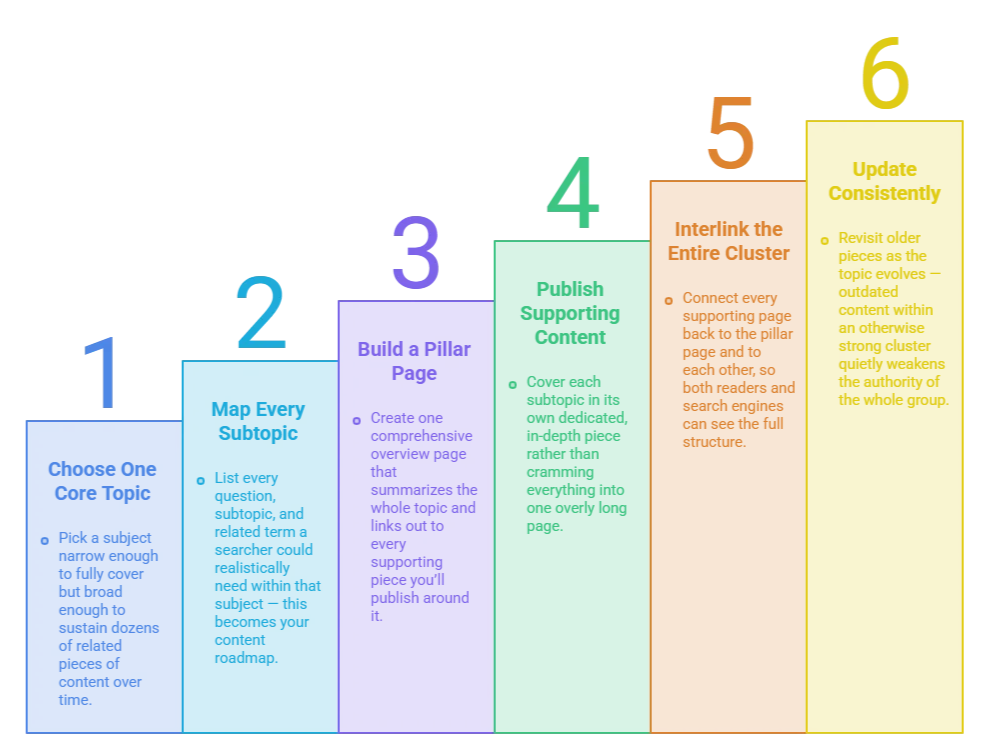
How to Earn Topical Authority: The Core Process
Building topical authority isn’t about writing more — it’s about mapping a subject properly before writing anything at all.
Choose One Core Topic
Pick a subject narrow enough to fully cover but broad enough to sustain dozens of related pieces of content over time.
Map Every Subtopic
List every question, subtopic, and related term a searcher could realistically need within that subject — this becomes your content roadmap.
Build a Pillar Page
Create one comprehensive overview page that summarizes the whole topic and links out to every supporting piece you’ll publish around it.
Publish Supporting Content
Cover each subtopic in its own dedicated, in-depth piece rather than cramming everything into one overly long page.
Interlink the Entire Cluster
Connect every supporting page back to the pillar page and to each other, so both readers and search engines can see the full structure.
Update Consistently
Revisit older pieces as the topic evolves — outdated content within an otherwise strong cluster quietly weakens the authority of the whole group.
Topic Clusters vs Random Publishing
The difference between a site that earns topical authority and one that doesn’t usually isn’t effort — it’s structure.
Internal Linking Is the Glue That Holds Authority Together
Even the most thorough content cluster underperforms if the pieces aren’t properly linked to one another. Internal links are how search engines actually understand that a group of pages belongs to the same topic rather than existing as unrelated content.
A strong pattern is linking every supporting article back to the pillar page, and linking closely related supporting articles to each other where it makes sense for the reader. This creates a web of relevance rather than a scattered pile of disconnected posts.
It’s worth periodically auditing this structure too. As a cluster grows, older pieces sometimes get left out of newer internal linking, quietly weakening the connections that built the authority in the first place.
Audit Your Internal Link Structure Regularly
Use our Website Internal Link Checker to spot orphaned pages and missing connections within your content clusters before they quietly cost you rankings.
Content Depth: How Thorough Is Thorough Enough?
There’s no fixed word count that guarantees topical authority. What matters is whether a piece of content leaves a genuine gap for the next competing article to fill.
A useful test: after finishing a draft, list the follow-up questions a curious reader might still have. If several obvious ones remain unanswered, the piece isn’t done yet, regardless of its length. For a deeper walkthrough of getting each individual piece right before it joins a cluster, see our guide on how to write an SEO-optimized article.
According to Search Engine Journal’s coverage of topical authority, sites that consistently produce comprehensive, well-organized content clusters tend to outperform competitors who publish isolated articles on the same subject, even when those competitors have stronger overall domain metrics.
Signals That Strengthen Topical Authority
Beyond content and internal links, a handful of supporting signals help reinforce topical authority over time.
Consistent terminology across a cluster — using the same core terms rather than switching phrasing randomly across articles — helps search engines confidently associate the whole group with one subject.
Structured data, such as article and FAQ schema, gives search engines an explicit, machine-readable signal about what each page covers, reinforcing the topic beyond just the visible text.
Earning a small number of relevant backlinks specifically to pillar and supporting pages — rather than only to the homepage — also tells search engines that outside sources see this specific cluster as valuable, not just the site in general.
How to Tell If Your Topical Authority Is Actually Growing
Since topical authority isn’t a single metric you can check directly, it helps to track a few indirect signals over time instead of waiting for one obvious confirmation.
Watch how many different pages within your cluster start ranking for related queries, not just your main pillar page. A growing spread of ranking pages across the same topic is one of the clearest signs the cluster is being recognized as a cohesive authority, rather than a handful of isolated wins.
Featured snippets and “People Also Ask” appearances are another useful signal. Search engines tend to pull these from sources they already associate with strong, structured coverage of a subject, so an increase here often reflects growing topical trust.
Finally, pay attention to how quickly new content in the cluster starts ranking compared to older, unrelated posts on the same site. A well-established topic cluster often gets new pages indexed and ranking noticeably faster than isolated content ever did, since search engines already understand where that new page fits.
Mistakes That Quietly Undermine Topical Authority
Frequently Asked Questions
How long does it take to earn topical authority?
How many articles are needed to build a topic cluster?
Can a small website compete for topical authority against bigger sites?
Does topical authority replace the need for backlinks?
Should I delete old content that doesn’t fit my topic cluster?
Final Thoughts
Learning how to earn topical authority in 2026 comes down to one shift in mindset: stop thinking in single articles and start thinking in complete topics.
Map the subject fully, build a strong pillar page, cover every subtopic in real depth, and connect it all with deliberate internal linking. That structure — not raw publishing volume — is what search engines increasingly reward with rankings that hold steady over time.