How to Cluster Keywords for Better SEO Strategy
Stop building one thin page per keyword — group them by intent and build fewer, stronger pages instead.
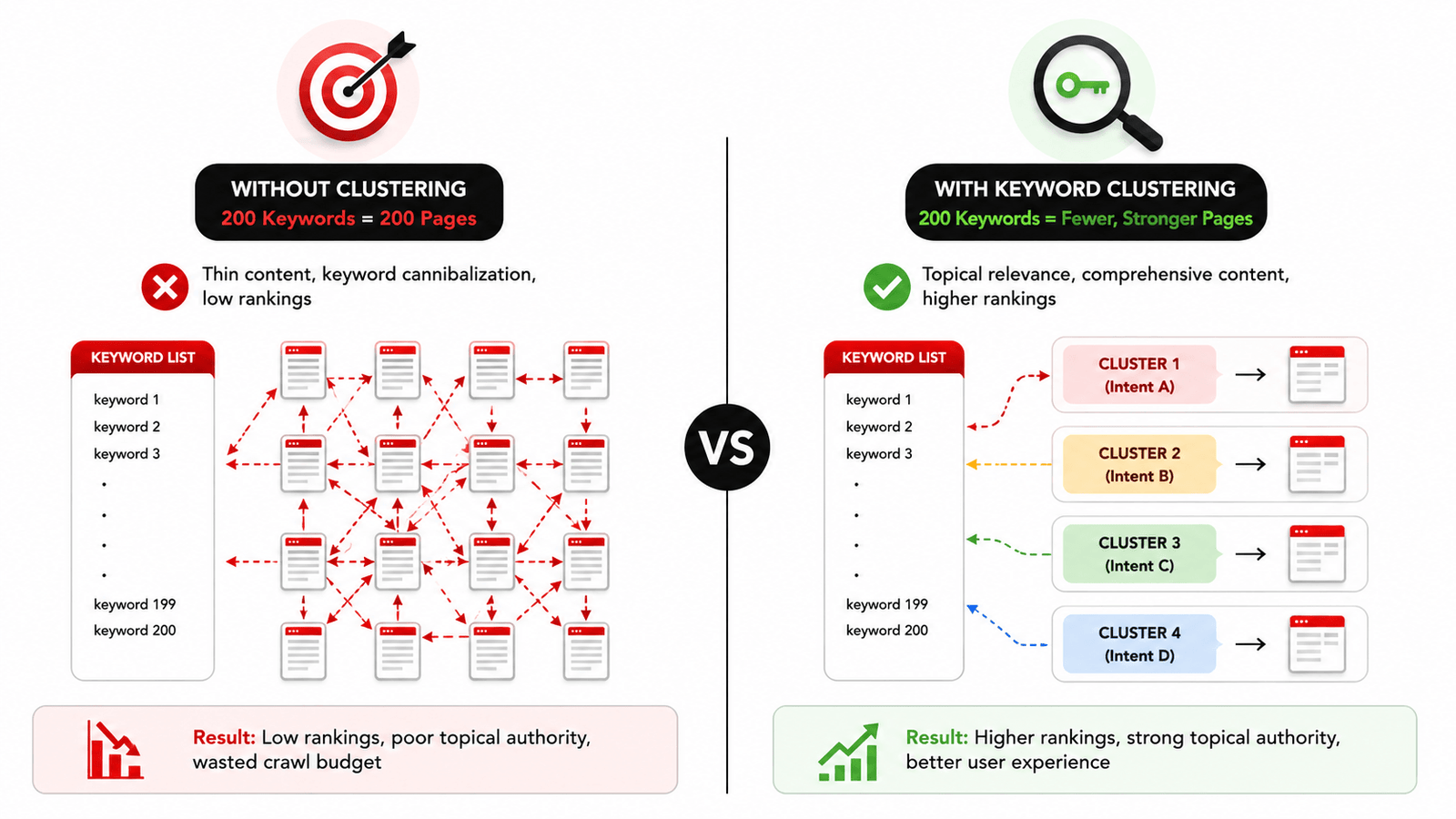
A keyword list with 200 entries looks productive, but treated as 200 separate content targets, it usually produces 200 thin, overlapping pages competing against each other instead of ranking. Keyword clustering fixes this by grouping keywords that share the same underlying intent, so each cluster becomes one genuinely comprehensive page instead of a handful of pages fighting for the same search results.
What Keyword Clustering Actually Means
Keyword clustering is the process of grouping keywords that a single page could realistically satisfy, based on shared search intent rather than just shared words. Two phrases can look completely different on the surface and still belong in the same cluster if a searcher typing either one would be happy with the same page.
The clearest signal for this is SERP overlap: if Google already shows largely the same set of pages ranking for two different keywords, that’s strong evidence Google itself considers them close enough in intent to satisfy with one page — which means you probably should too.
Why Clustering Beats One-Keyword-Per-Page
The old approach — a dedicated page for every individual keyword — creates a problem called keyword cannibalization, where multiple pages on the same site compete against each other for the same search results. Instead of one strong page ranking well, two or three weak pages split relevance, authority, and clicks, often resulting in none of them ranking particularly well. Google’s own guidance on consolidating duplicate or overlapping URLs makes the same point: signals get split across near-duplicate pages instead of reinforcing one strong one.
Clustering also produces genuinely better content. A page built to answer one narrow keyword tends to be thin. A page built to comprehensively cover an entire cluster of related questions naturally becomes deeper, more useful, and more likely to earn the kind of engagement — time on page, internal clicks, return visits — that search engines increasingly reward.
The Pillar-Cluster Model
Most keyword clustering strategies organize around a pillar page — a broad, comprehensive page covering a topic fully — supported by cluster pages that go deeper on specific sub-topics, all interlinked.
The pillar page targets the broad, high-volume keyword. Each cluster page targets a narrower, related keyword group in more depth, and links back to the pillar — building a structure that signals topical authority to search engines while genuinely helping readers navigate related content.
How to Cluster Keywords Step by Step
Start With a Full Keyword List
Gather your complete list from keyword research — seed terms, autocomplete expansions, and “People also ask” questions — before attempting to organize anything.
Check SERP Overlap for Ambiguous Pairs
For keywords where intent isn’t obviously identical or distinct, search both and compare the top 10 results — significant overlap suggests they belong in the same cluster.
Group by Shared Intent, Not Shared Words
Two keywords sharing a word aren’t automatically related, and two keywords with no overlapping words can still belong together if the intent genuinely matches.
Use a Clustering Tool for Scale
Manually grouping dozens or hundreds of keywords is slow — a keywords clustering tool speeds this up significantly by grouping related terms automatically.
Assign One Page Per Cluster
Each finished cluster becomes exactly one content target — resist the urge to split a cluster across multiple pages even if it feels like a lot to cover in one place.
Map Clusters Into a Pillar Structure
Identify which clusters are broad enough to be pillar pages and which are narrower supporting content, then plan the internal linking between them before writing begins.
A Worked Example: Raw List to Clusters
Here’s an unsorted list of 9 keywords for a yoga-focused site:
Grouped by intent, this becomes three clean clusters:
Nine keywords became three well-defined content targets instead of nine thin, overlapping pages — exactly the outcome clustering is meant to produce.
Clustering Follows Keyword Research
Clustering only works once you have a real keyword list to organize — see How to Do Keyword Research for SEO for the full process of building that list in the first place.
Common Keyword Clustering Mistakes
Frequently Asked Questions
What is keyword clustering in SEO?
How do I know if two keywords belong in the same cluster?
What’s the difference between a pillar page and a cluster page?
Can keyword clustering be done manually without a tool?
Does keyword clustering fix existing keyword cannibalization?
Final Thoughts
Keyword clustering turns a flat, overwhelming list of keywords into a genuinely usable content plan — fewer pages, each one deeper and stronger, instead of many thin pages competing against each other. Start from a full keyword list, group by real intent rather than surface-level word matching, and organize the result into a pillar-cluster structure before writing a single page.