
Customer Acquisition Cost Calculator — Free Online Tool
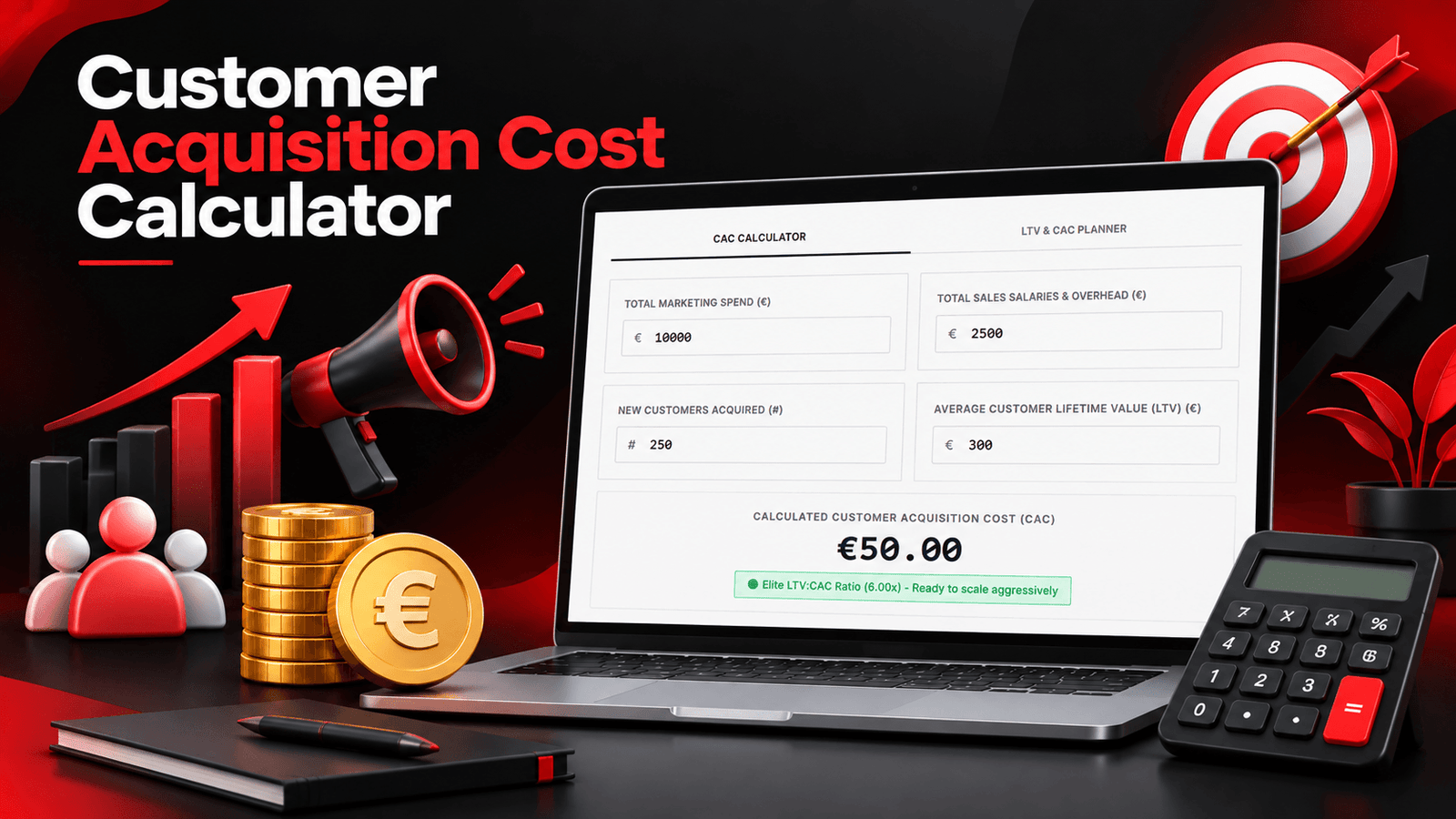
Knowing how much you spent on marketing last month is easy. Knowing whether that spend is actually building a sustainable business is a different question entirely — and it comes down to one number: your Customer Acquisition Cost. That's exactly what our Customer Acquisition Cost Calculator was built to reveal. Instead of manually dividing spend by customer counts and separately tracking lifetime value in another spreadsheet, you enter a handful of numbers and instantly see your CAC, your LTV:CAC ratio, and how long it takes to earn that acquisition cost back.
Whether you're a startup founder reporting to investors, a growth marketer optimizing channel spend, or a small business owner trying to understand if your marketing is actually working, this tool gives you the complete picture in seconds. Once you know your CAC, check it against your paid campaign performance with our Google Ads ROAS Calculator to see whether that acquisition spend is actually paying off.
What Is a Customer Acquisition Cost Calculator?
A Customer Acquisition Cost Calculator is a tool that converts your total marketing and sales spend into the cost of acquiring a single customer, then compares that figure against what each customer is actually worth over their lifetime. Rather than calculating CAC in one place and LTV in another, you get both numbers — plus the ratio between them — in a single instant result.
01. Saves Time
No more rebuilding the same CAC formula in a spreadsheet every reporting period.
02. Full Picture, Not Just Spend
Factors in overhead and sales costs alongside ad spend for a more honest number.
03. Instant Verdict
Get a clear, color-coded read on whether your acquisition cost is healthy, tight, or unsustainable.
Why a Single CAC Number Isn't Enough
Most people calculate CAC once and move on, without asking the more important follow-up question. Here's the problem this tool solves:
A CAC of €50 sounds fine until you realize your average customer is only worth €40 over their lifetime.
Many DIY CAC calculations only include ad spend, ignoring sales salaries and overhead that are just as much a part of acquiring a customer.
Even a good LTV:CAC ratio can hide a slow payback period that strains cash flow in the meantime.
This Customer Acquisition Cost Calculator addresses all three at once — a complete cost input, an instant ratio against customer value, and a payback period estimate so you know not just if you're profitable, but how quickly.
How the Customer Acquisition Cost Calculator Works
Using the tool takes less than a minute. Here's the process:
Input your total ad and marketing spend for the period.
Include the cost of sales team salaries and related overhead tied to acquiring customers.
Add the total number of new customers gained during that same period.
Input your average LTV per customer.
See your CAC, total investment, LTV:CAC ratio, and estimated payback period update live as you adjust any input.
Switch to the second tab to see how your ratio compares against standard industry benchmarks.
No sign-up, no spreadsheet setup — just an instant, complete acquisition cost breakdown every time you check.
Key Features of This Customer Acquisition Cost Calculator
- Complete Cost Input — Combines marketing spend and sales overhead into one true total investment figure.
- Instant CAC Calculation — See your cost per customer update live as you type.
- LTV:CAC Ratio — Instantly compares your acquisition cost against customer lifetime value.
- Estimated Payback Period — Shows roughly how many months it takes to earn back what you spent acquiring each customer.
- Color-Coded Verdicts — Instantly see whether your ratio is elite, healthy, tight, or unprofitable.
- Built-In Benchmark Matrix — Compare your result against standard industry LTV:CAC ranges without researching them separately.
- 100% Free and Private — Everything runs directly in your browser; no data is uploaded or stored.
Understanding the Metrics This Tool Calculates
CAC (Customer Acquisition Cost)
Your total marketing spend plus sales overhead, divided by the number of new customers acquired — the true cost of winning one customer.
Total Investment
The combined total of your marketing spend and sales salaries/overhead for the period being measured.
LTV:CAC Ratio
Your average customer lifetime value divided by your CAC, showing how many times over you earn back what you spent to acquire that customer.
Estimated Payback Period
A rough estimate, in months, of how long it takes to recover your acquisition cost based on the customer's average monthly value. Once you know your payback window, use the Break Even ROAS Calculator to see the minimum return each campaign needs to hit before it can even start paying that back.
Who Should Use a Customer Acquisition Cost Calculator?
Startup Founders
Get an investor-ready CAC and LTV:CAC figure without building a financial model from scratch every time it's requested.
Growth Marketers
Quickly sanity-check whether a channel's acquisition cost is sustainable relative to what customers from that channel are actually worth. Cross-check channel efficiency with our Cost Per Click Calculator to see where spend is being wasted.
Small Business Owners
Understand whether your marketing spend is genuinely building the business or quietly eating into margins you haven't noticed yet.
Agencies Reporting to Clients
Generate quick, defensible CAC and payback period figures for client reporting without rebuilding the same formulas each cycle. Pair it with the SEO ROI Calculator for a full picture across paid and organic acquisition.
Finance & Operations Teams
Cross-check marketing-reported CAC figures against a full-cost calculation that includes sales overhead, not just ad spend.
Reading the LTV to CAC Benchmark Matrix
Beyond the main calculator, this tool includes a built-in reference table mapping LTV:CAC ratio ranges to business health categories. A ratio below 1.0x means you're losing money on every customer — a critical, stop-immediately signal. A ratio between 1.0x and 2.9x is generally underperforming and worth optimizing. The commonly cited "healthy" range sits between 3.0x and 4.0x, which is the standard benchmark used across e-commerce and SaaS growth. Anything above 4.0x typically signals room to scale marketing spend more aggressively, since you're likely leaving growth on the table by holding back budget. Having this matrix built directly into the calculator means you don't need to separately research what a "good" ratio actually looks like for your industry.
Tips for Getting the Most Accurate Results
Include sales salaries and overhead in your cost input, not just ad spend, for a CAC figure that reflects true acquisition cost.
Use a realistic, data-backed LTV figure rather than an optimistic estimate, since it directly changes your ratio and payback period.
Recalculate by channel where possible, since blended CAC across all channels can hide underperforming ones.
Treat the payback period as a cash-flow signal, not just a profitability one — a healthy ratio with a very long payback can still strain working capital.
Revisit your numbers regularly, since both marketing costs and customer value shift over time even when your overall strategy hasn't changed.
Frequently Asked Questions
Final Thoughts
A single CAC figure without context doesn't tell you much — what matters is how that cost compares to what a customer is actually worth, and how quickly you get that investment back. This tool gives you the complete picture instantly, whether you're reporting to investors, optimizing a marketing channel, or just trying to understand if your growth is sustainable. No spreadsheet formulas, no guesswork — just a clear, immediate read on your true cost per customer. For the paid-acquisition side of that spend, pair it with our Google Ads ROAS Calculator and Break Even ROAS Calculator to see the full path from ad spend to sustainable profit.
For more on CAC and growth metrics, see Harvard Business Review's guide on customer acquisition economics for further detail on measuring marketing efficiency.
Try the Customer Acquisition Cost Calculator now and see exactly what it really costs you to win a customer.