Best YouTube SEO Tips for Beginners
A clear, no-fluff starting point for getting your videos found — covering keywords, titles, thumbnails, and the ranking signals that actually matter in 2026.
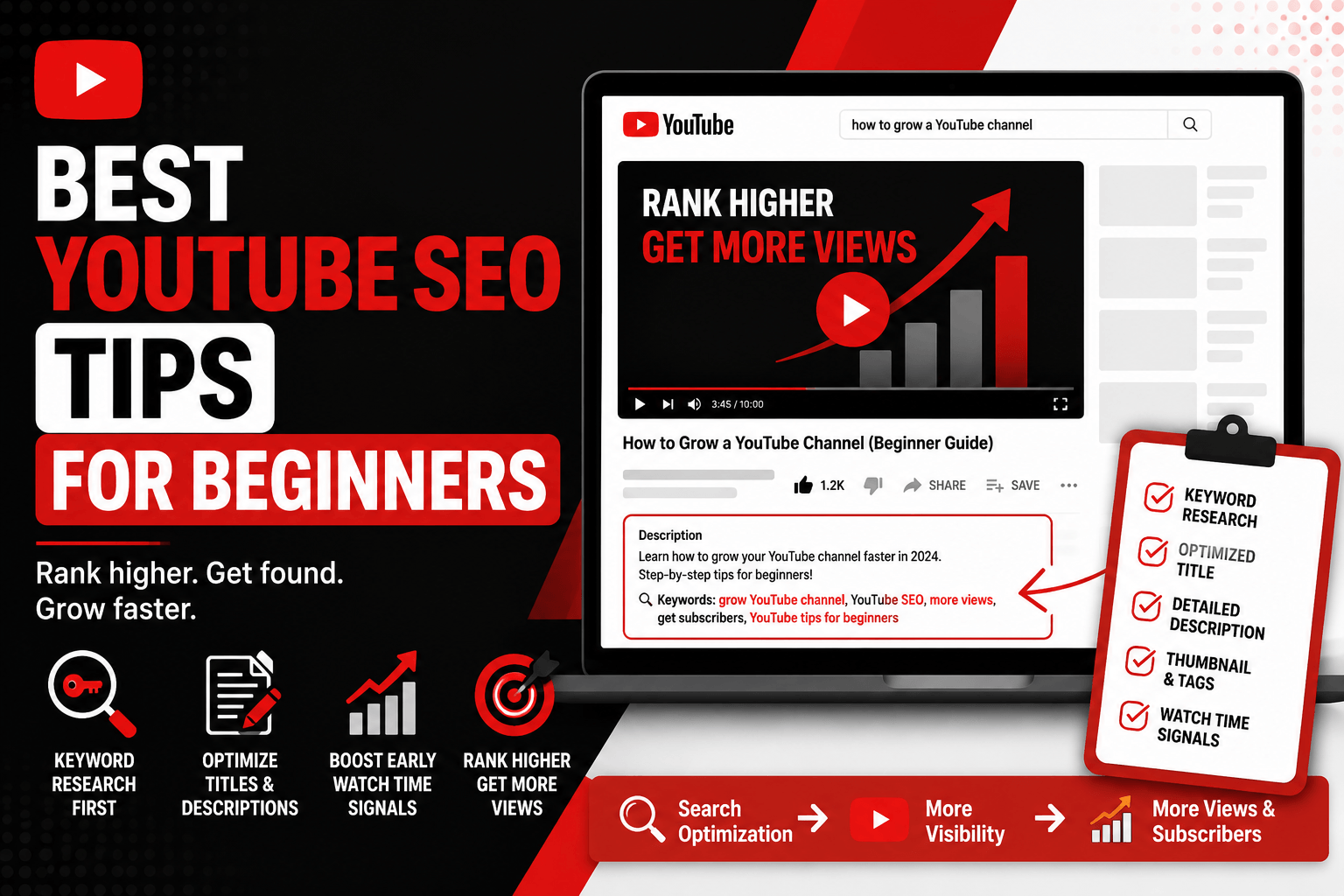
Uploading a great video isn’t enough if nobody searches their way to it. These best YouTube SEO tips for beginners cover exactly what actually moves the needle — keyword research before filming, titles and descriptions that match real searches, and the early watch-time signals YouTube’s algorithm rewards most.
The best YouTube SEO tips for beginners are: research keywords before filming, put the target keyword naturally in the title and first line of the description, write a detailed description with timestamps, use accurate tags, and design a thumbnail that earns clicks without misleading viewers. Early watch time and click-through rate matter more than any single tag or keyword placement.
Why YouTube SEO Works Differently Than Google SEO
YouTube is the second-largest search engine in the world, but it doesn’t rank videos the same way Google ranks web pages.
Keywords still matter for getting discovered in search, but YouTube’s algorithm leans heavily on engagement signals after someone clicks — watch time, audience retention, and whether people keep watching more of your content afterward.
A perfectly optimized title with weak retention still struggles to rank.
That’s why the best YouTube SEO tips for beginners always combine two layers: getting found through search and keywords, and then earning the watch-time signals that keep a video ranking once people arrive.
Best YouTube SEO Tips for Beginners: Where to Start
Before touching titles or thumbnails, get the foundation right. Skipping these steps is the most common reason beginner channels struggle to get discovered.
Research Keywords Before Filming
Use YouTube’s own search bar autocomplete, or a dedicated keyword tool, to confirm people are actually searching for your planned topic before you script it.
Write a Clear, Keyword-Rich Title
Lead with the main keyword naturally, keep it under 60 characters where possible, and avoid vague titles that don’t describe the actual content.
Write a Detailed Description
Include the target keyword in the first sentence, summarize the video’s value, and add timestamps for longer content.
Add Accurate, Specific Tags
Tags carry less weight than they used to, but specific, accurate ones still help YouTube understand context and related topics.
Design a Thumbnail That Earns Clicks
High contrast, clear focal point, and a promise that matches the video’s actual content — misleading thumbnails hurt retention and rankings long-term.
Hook Viewers in the First 15 Seconds
Early drop-off is one of the strongest negative signals YouTube tracks, so open with the value, not a long intro.
Titles, Descriptions, and Tags: What Actually Matters
Not every optimization element carries the same weight. Here’s a realistic breakdown for beginners deciding where to focus their time.
Watch Time and Retention: The Real Ranking Engine
Keywords get a video discovered. Retention is what keeps it recommended after that first click.
YouTube tracks how long viewers stay, whether they watch to the end, and whether they click into another video from the same channel afterward. Videos that hold attention consistently get pushed further into search results and suggested feeds, regardless of how perfectly the title was optimized.
For beginners, the practical takeaway is simple: a slightly less “perfect” title paired with genuinely engaging content will outperform a perfectly optimized title attached to a video people click away from within 30 seconds.
Check Your Title Length Before Publishing
Titles that get cut off in search results or suggested feeds lose impact. Use our YouTube Title Length Checker to make sure your full message displays across devices.
Channel-Level SEO Beginners Often Skip
Individual video optimization matters, but channel-wide signals influence how much YouTube trusts and promotes your content overall.
A clear channel name relevant to your niche, a complete “About” section with keywords describing what you cover, and organized playlists grouping related videos together all help YouTube understand your channel’s topic focus — similar to how topical authority works for websites.
Consistency also matters at the channel level. Uploading on a predictable schedule around a clearly defined niche tends to build momentum faster than sporadic uploads across unrelated topics.
A branded channel banner and consistent thumbnail style across videos might seem purely cosmetic, but they quietly reinforce recognition. Viewers who recognize a channel’s visual style at a glance in search results or suggested feeds are more likely to click, which feeds back into the same watch-time signals that drive rankings.
Choosing Your First Video Topics Strategically
Beginners often pick topics based on what feels exciting to make rather than what people are actually searching for. Both matter, but search demand should come first.
Look for topics with clear search intent but manageable competition — a specific, narrow question tends to be easier to rank for as a new channel than a broad, heavily contested term.
According to Backlinko’s research on YouTube ranking factors, videos that closely match a specific search query’s intent consistently outperform broader, less targeted content in both search and suggested placements.
Once a few specific videos start gaining traction, expanding into closely related, slightly broader topics becomes far easier than starting broad from day one.
This same principle applies whether you’re building a single channel or planning content across several niches — narrow first, broaden gradually as each topic proves itself in search and retention data.
Playlists and Suggested Video Strategy
One of the most overlooked best YouTube SEO tips for beginners is treating playlists as a discovery tool rather than just a way to organize old videos.
A well-structured playlist keeps viewers watching multiple videos back to back, which directly feeds the watch-time signal YouTube rewards most. Grouping closely related videos into a logical playlist order — beginner to advanced, or step one to step five — encourages exactly this kind of extended viewing session.
Playlists also show up in their own search results separately from individual videos, giving beginners a second discovery path for the same content without creating anything new.
Using Analytics to Improve Future Videos
YouTube Studio’s analytics dashboard quietly holds some of the most useful SEO information available, yet many beginners barely glance at it beyond view counts.
The audience retention graph is especially valuable — it shows exactly where viewers drop off, which reveals whether an intro is too long, a segment drags, or the video simply runs longer than the topic justifies. Fixing these drop-off points in future videos compounds retention gains across the entire channel over time.
The traffic source report is equally useful, showing whether views are coming from search, suggested videos, or external sources. A channel getting most of its views from search confirms that keyword and title choices are genuinely working, while a channel relying entirely on suggested placements may need to revisit its on-page optimization.
Mistakes Beginners Make With YouTube SEO
Frequently Asked Questions
What is the most important YouTube SEO factor for beginners?
Do tags still matter for YouTube SEO in 2026?
How long should a YouTube title be for SEO?
Should beginners focus on Shorts or long-form videos for SEO?
How soon can a new channel expect to rank in YouTube search?
Final Thoughts
The best YouTube SEO tips for beginners all point to the same principle: get discovered through smart keyword and title choices, then keep viewers watching once they arrive.
Start with proper keyword research before filming, write titles and descriptions that genuinely reflect the content, and design thumbnails that earn honest clicks. Everything else on this list supports that core loop.