
Keywords Clustering Tool: The Smarter Way to Organize Your SEO Strategy
If you've ever spent hours building a keyword list only to watch your content sink without a trace in search results, you're not alone. Most digital marketers understand the basics — find keywords, create content, repeat.
But the uncomfortable truth is that raw keyword lists, no matter how long or carefully researched, don't automatically translate into rankings. What separates effective SEO from wasted effort is often a single, underused step: keyword clustering.
A Keywords Clustering Tool takes the chaos out of keyword organization by grouping semantically related terms together, giving your content strategy a clear, logical structure. In today's increasingly competitive search environment — where a handful of well-optimized pages consistently dominate the first page — understanding how to cluster keywords isn't just helpful. It's essential.
It is one of the many free SEO tools available at onlinetoolix.
What Is Keyword Clustering, and Why Does It Matter?
Keyword clustering is the process of grouping keywords by shared intent, topic, or meaning. Rather than creating a separate page for every single keyword variation, clustering allows you to build one authoritative piece of content that addresses an entire group of related queries at once.
Search engines like Google don't just look at individual keywords in isolation. They evaluate the topical depth and semantic relevance of your content. A page that naturally addresses a cluster of related terms signals greater expertise and comprehensiveness than a page laser-focused on a single phrase. According to Google's own Search documentation, creating helpful, people-first content that thoroughly covers a topic is a core signal of quality — which is exactly what a cluster-based approach is designed to achieve.
Example: Running Shoes Cluster
This is where a Keywords Clustering Tool becomes indispensable. Instead of manually sifting through hundreds or thousands of keywords to find thematic patterns, the tool automates that grouping process using algorithms that detect word overlap, semantic similarity, and search intent — in seconds.
How a Keywords Clustering Tool Works
A well-designed Keywords Clustering Tool operates on two core mechanisms: string similarity (how closely two keyword phrases resemble each other at the character or word level) and semantic proximity (how closely related two keywords are in meaning or topic).
Clustering Algorithm
String similarity — measures how many character edits separate two strings. Detects near-identical keyword variations at the character level.
Word overlap — calculates how many words two phrases share relative to their total unique word count. Identifies topically related terms.
Adjustable threshold — low sensitivity (closer to 1) produces broader clusters; high sensitivity (closer to 10) creates tighter, more precise groupings. Broad clusters work for content pillars; tight clusters identify cannibalization.
Representative keyword — when keywords cross the similarity threshold, they're grouped under the most representative term in the group.
How to Use the Keyword Clustering Tool
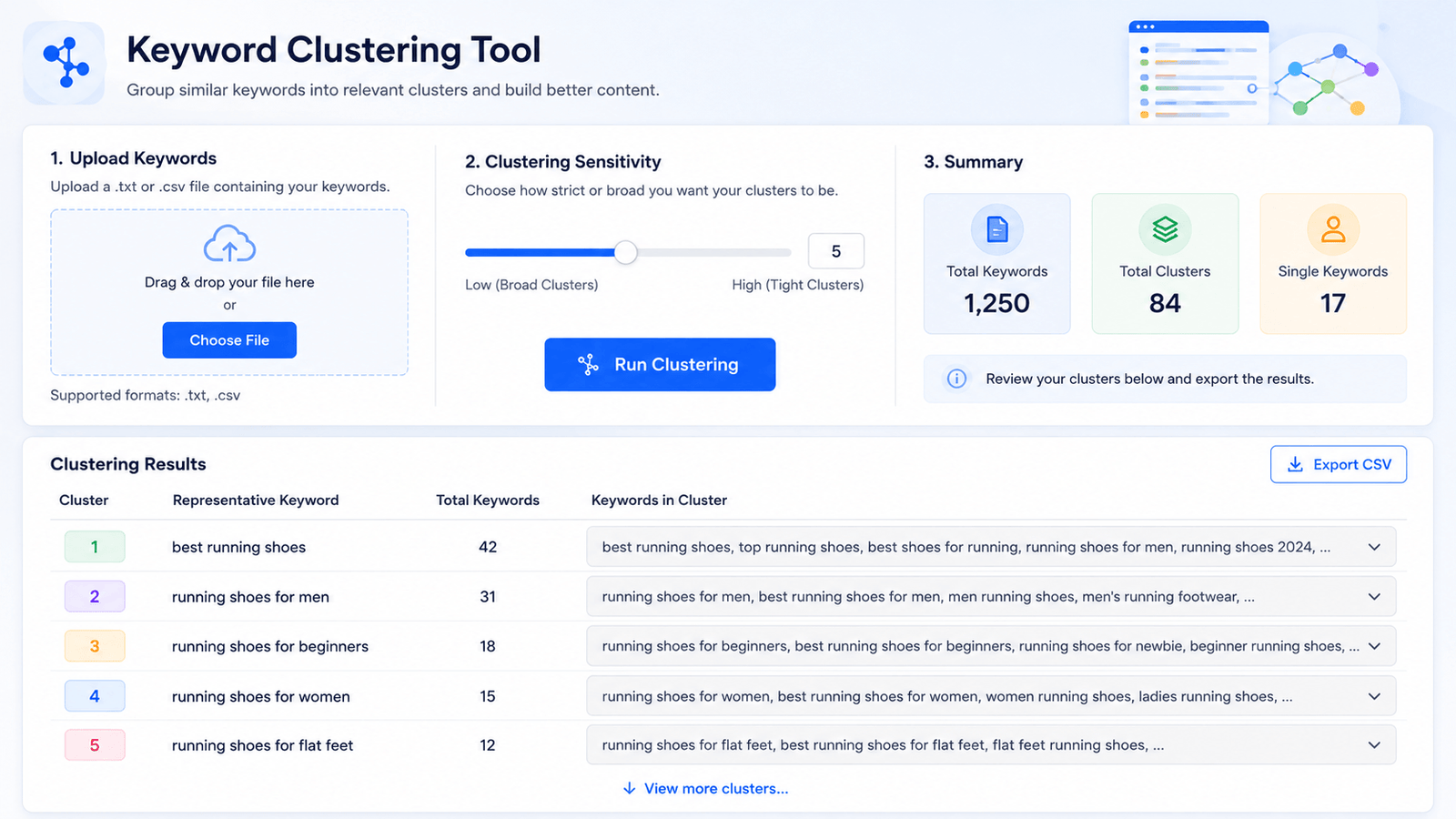
Using our Keyword Clustering Tool is simple. You can organize a large list of SEO keywords into relevant groups in just a few steps.
Collect the keywords you want to analyze from sources such as Google Search Console, Google Keyword Planner, Ahrefs, SEMrush, or other keyword research tools.
For best results, keep one keyword per line in your TXT file or use a CSV file with a keyword column.
Upload your .TXT or .CSV file using the Upload File option.
You can also use a keyword list containing hundreds or thousands of keywords, depending on the tool's supported limit.
Select the appropriate Clustering Sensitivity level before starting the analysis.
Low sensitivity: Creates broader keyword groups.
Medium sensitivity: Creates balanced groups with closely related keywords.
High sensitivity: Creates smaller and more specific keyword groups.
If you're unsure, start with a medium setting and adjust it based on the results.
Click Run Clustering to analyze your keyword list.
The tool compares the keywords and groups terms that are sufficiently similar according to the selected sensitivity level.
Once the process is complete, review the generated clusters. You can see information such as:
Total keywords analyzed · Total clusters created · Unclustered keywords · Keywords included in each cluster · Representative or primary keywords
Reviewing the groups helps you identify which keywords can potentially be targeted together.
Use the resulting clusters to plan your website content. For example, keywords such as "best running shoes," "top running shoes," and "best shoes for running" may belong to the same topic and can potentially be covered by one comprehensive page.
However, always consider search intent and SERP similarity before deciding whether multiple keywords should target the same page.
After reviewing the clusters, use the Export CSV option to save your results. You can then use the exported keyword groups for content planning, keyword mapping, topic research, content briefs, SEO campaigns, and identifying potential keyword cannibalization.
Tip: For the best results, start with a clean keyword list and remove irrelevant or duplicate keywords before clustering.
Example: How Keyword Clustering Works
Suppose you have collected the following keywords for the topic running shoes:
Input Keywords
Instead of creating a separate page for every keyword, the Keyword Clustering Tool groups closely related keywords based on their similarity and search intent.
Cluster 1: Best Running Shoes
Recommended Content: Create one comprehensive page targeting the main topic Best Running Shoes and naturally cover the related variations within the same content.
Cluster 2: Running Shoes for Beginners
Recommended Content: Create a dedicated guide for beginners that explains how to select suitable running shoes and covers beginner-focused variations.
Cluster 3: Running Shoes for Men
Recommended Content: Create a dedicated page targeting men's running shoes if the keywords have sufficiently similar search intent.
Cluster 4: Running Shoes for Women
Recommended Content: Create a page focused on women's running shoes and address the related keyword variations naturally.
Cluster 5: Running Shoes for Flat Feet
Recommended Content: Create a dedicated guide or category page focused specifically on running shoes suitable for people with flat feet.
From Keywords to Content Clusters
The clustering process turns a large keyword list into a more organized content plan:
For example:
| Keyword Cluster | Primary Keyword | Keywords | Suggested Content |
|---|---|---|---|
| Best Running Shoes | best running shoes | 3 | Buying Guide |
| Beginners | running shoes for beginners | 3 | Beginner Guide |
| Men | running shoes for men | 2 | Dedicated Guide |
| Women | running shoes for women | 2 | Dedicated Guide |
| Flat Feet | running shoes for flat feet | 2 | Specialized Guide |
Important SEO Note: Keyword clustering does not mean that every cluster must automatically become a separate page. The final decision should consider search intent, SERP similarity, and the type of content ranking for those keywords.
The goal is to identify keywords that can realistically be targeted together while avoiding unnecessary pages and keyword cannibalization.
Key Features That Make This Tool Stand Out
Rather than forcing you to manually type every keyword, the tool supports drag-and-drop upload for .txt and .csv files. If you're working with keyword exports from Google Search Console, Ahrefs, or SEMrush, drop that file directly into the interface and start clustering immediately.
The sensitivity slider puts control directly in your hands, letting you define what "similar enough" actually means for your specific use case. A blogger writing broadly about fitness might want loose clusters; an e-commerce site optimizing hundreds of product-specific queries needs tight, precise groupings.
After running the analysis, the tool displays three key metrics: total keywords processed, number of clusters created, and the count of "solo" keywords that didn't fit into any cluster. That last number is particularly valuable — solo keywords are candidates for either combining with existing content or flagging as low-priority terms.
Once clusters are generated, export the full results as a structured CSV file. Each row pairs a keyword with its cluster head, making it easy to feed results directly into your content planning workflow, a spreadsheet, or a project management tool.
Practical Applications for Your SEO Strategy
The real value of a Keywords Clustering Tool shows up in three distinct workflows.
When building a content calendar, clusters tell you exactly what topics to cover and which keywords to target within each piece. A cluster around "home coffee brewing" might include "pour over coffee method," "best coffee-to-water ratio," and "how to use a French press" — all addressable in a single comprehensive guide.
Keyword clusters help you identify every semantically related term that should appear naturally within a piece of content. This isn't about stuffing keywords — it's about ensuring your content is thorough enough that search engines and readers recognize it as a complete resource on the topic.
Running your existing site's indexed URLs through a Keywords Clustering Tool can reveal two problems: gaps (topics your site hasn't covered) and cannibalization (multiple pages competing for the same cluster). Both issues quietly suppress rankings — clustering makes them visible.
Addressing the Real Frustration: When Hard Work Doesn't Rank
There's a particular kind of SEO frustration that's almost universal: you publish well-researched, well-written content, wait months, and watch it stagnate on page three. Often, the culprit isn't the writing quality or even the backlink profile — it's the structural logic (or lack thereof) behind the keyword strategy.
Publishing one page per keyword, without regard for clustering, often results in thin, fragmented content. Each page covers too narrow a topic to demonstrate topical authority, and collectively they dilute your site's relevance signals rather than amplifying them.
A Keywords Clustering Tool directly addresses this by encouraging a topic-first, cluster-based approach to content architecture — one that aligns far better with how modern search engines evaluate and rank pages. For insight into how search engines assess keyword relevance across your pages, also use our keyword prominence checker.
Who Should Be Using This Tool?
Frankly, almost anyone involved in content-driven SEO stands to benefit.
Digital marketing professionals managing large keyword portfolios will save hours of manual sorting with automated cluster detection.
Small business owners without dedicated SEO resources get an accessible, free entry point into more sophisticated keyword strategy.
Content creators who want to write for people and search engines can use clusters to map out articles that are both readable and comprehensive.
SEO professionals auditing existing content libraries can use clusters to identify cannibalization issues and content gaps that are suppressing rankings.
Anyone already doing keyword research who hasn't yet taken the step of organizing keywords into logical groups before writing — that single structural improvement is consistently one of the highest-leverage changes a site can make.
Frequently Asked Questions
Keyword clustering is the process of grouping related keywords based on their similarity, topic, and search intent. It helps you identify which keywords can be targeted together on the same page and which ones may require separate content.
A keyword clustering tool analyzes your keyword list and identifies keywords that are closely related. Depending on the tool, clustering can use factors such as word similarity, keyword overlap, semantic relationships, or search intent to create relevant keyword groups.
Keyword clustering helps organize your keyword research into meaningful content topics. Instead of creating separate pages for every keyword variation, you can identify groups of related keywords and build focused content around them, which can also help reduce unnecessary keyword cannibalization.
The number of keywords depends on the tool and the input method. For large keyword lists, you can upload your keywords using a supported CSV or TXT file. Clustering a larger list can help you organize extensive keyword research into manageable topic groups.
The right sensitivity depends on how closely you want keywords to match. A lower sensitivity generally creates broader clusters, while a higher sensitivity creates smaller and more closely related groups. If you're unsure, start with a balanced setting and adjust it based on the results.
No. A keyword cluster does not automatically mean you need to create a separate page. Consider the search intent and SERP results before deciding. Keywords with the same intent can often be targeted on one page, while keywords with substantially different intent may deserve separate pages.
Yes. Keyword clustering can help identify keywords with similar search intent that may be better targeted on the same page. This can reduce the risk of creating multiple pages that compete for closely related search queries.
Cluster First, Rank Better
The days of one-keyword-one-page SEO are over. Search engines have grown sophisticated enough to reward depth, relevance, and topical authority — and penalize thin, scattered content that addresses no single topic with real conviction.
A Keywords Clustering Tool is the bridge between raw keyword data and a strategy that actually works. By grouping related terms before you write a single word of content, you build pages that satisfy both searchers and algorithms: comprehensive enough to rank, focused enough to convert.
Whether you're starting from scratch or auditing an existing content library, the Keywords Clustering Tool gives you the structural clarity that effective SEO demands. The keywords are already there. It's time to organize them into something that actually moves the needle.